Las Vegas, renowned as the Entertainment Capital of the World, has become famous for its hotel-resort casinos and world-class entertainment. As the 30th most populous city in the country, it’s one of the top destinations for conventions and business and is also one of the wealthiest major cities in the United States. It offers an unparalleled quality of life that continues to draw new residents from around the globe.
Let’s take a look back at the history that helped create the Las Vegas we know and love today.
Las Vegas History: The Railroad into Development
In its mere beginnings, Southern Nevada was a harsh desert landscape that could only support the hardiest of plants and animals with human presence dating back more than 10,000 years. Due to the unforgiving Mojave Desert, much of the Las Vegas Valley was protected from discovery.
As a Native American oasis to the Wild West, Las Vegas has seen a lot of changes throughout the years. Spanish for “the meadows”, Las Vegas contained artesian wells that supported extensive areas and was named by Mexicans that were a part of a trade caravan led by Mexican merchant Antonio Armijo. Charged with establishing a trade route to Los Angeles, Armijo and his party came upon the Las Vegas Valley as a point to re-supply before continuing to California.
Years later, in 1844, John Fremont was appointed by the President to lead a group of scientists, spies and scouts for the U.S. Army as they prepared for a possible war with Mexico. Though Las Vegas was still a part of Mexico at this time, after the war, it became a part of the U.S. territory and remained unoccupied by Americans – except for travelers and traders.
Following the shift from Mexican to American rule in 1848, not much changed in the area until Brigham Young sent a group of Mormon settlers to the area. The Mormons began building a 150 square foot fort and planted fruit trees and vegetables in the area. Unfortunately, their settlement was not successful, partially due to Indian raids, but their abandoned fort became known as the best stop on the Old Spanish Trail and Octavius Gass, who named the area “Los Vegas Rancho”, started irrigating old fields.
By 1872, Gass expanded his area to approximately 640 acres. As the property continued to increase it became more appealing to potential buyers and was finally purchased in 1902 by the San Pedro, Los Angeles and Salt Lake Railroad. Through the efforts of Montana Senator William Clark and Mining Magnate Thomas Kearns, the land was promoted to American farmers. Through wells and irrigation, the area quickly expanded and Las Vegas became the home to a booming agricultural industry. The local farmers named the area Clark County after William Clark.
In the 20th Century, Las Vegas became a water stop on the trail between Los Angeles and Albuquerque. Shortly thereafter, the railroad was completed, which linked Salt Lake City to Southern California, and became
the country’s main rail network. In 1905, Las Vegas was officially founded as a city and a driving force of Clark County. Shortly after in 1911, it was incorporated.
Las Vegas: Gambling & The Mob
Though Nevada reluctantly became the last state in the west to outlaw gambling, the practice continued in speakeasies and illicit casinos. By the time it was legalized again in the 1930’s, organized crime already had roots in the city.
By 1931, work started on the Hoover Dam and the population grew from a mere 5,000 to 25,000, with most people coming in hopes of getting a job working on the dam. With a large number of male workers, Vegas businesses with the help of Mormon financiers and Mafia crime bosses, developed several casinos and showgirl theaters. This was the start of the realization that gambling would be a profitable sector for local businesses and the city.
The first gambling license was issued in 1931 to the Northern Club, and shortly thereafter, other casinos made their mark in the area. Fremont Street became the first paved street in Las Vegas and was home to the city’s first traffic light.
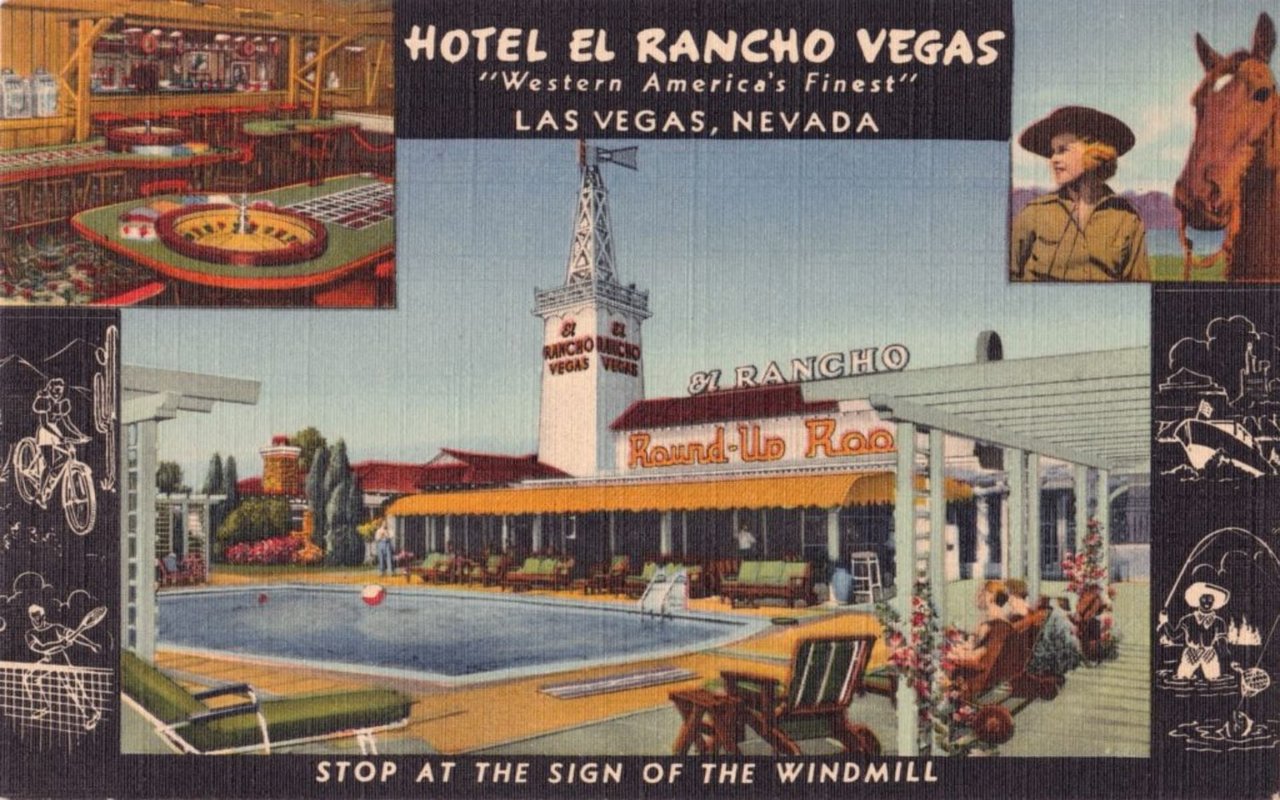
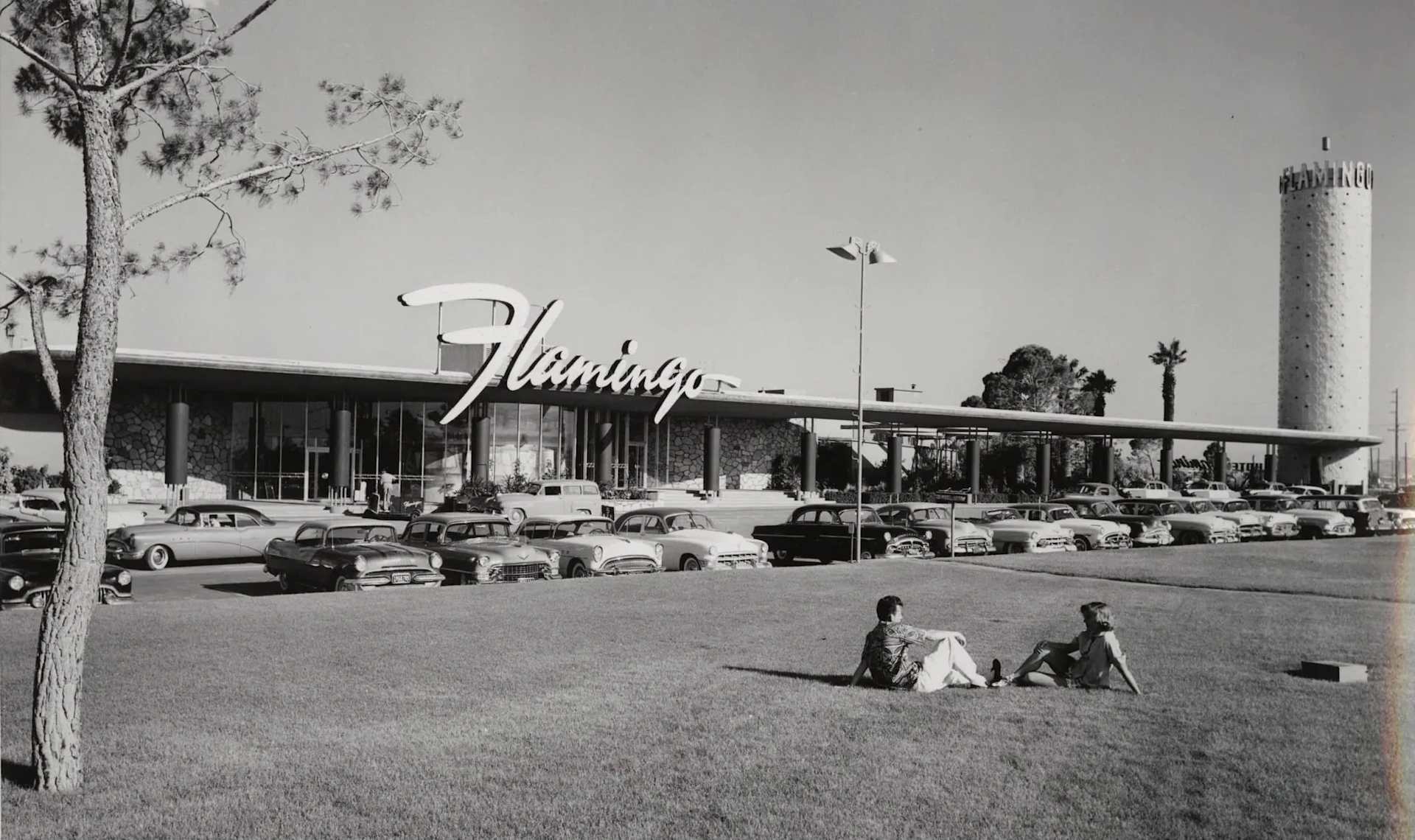
In 1941, the first resort on what would later become the Vegas Strip opened and was called El Rancho Vegas. The owner, Thomas Hull offered its patrons a gourmet buffet that helped the resort gain its momentum. The next hotel built on the Strip was The Flamingo in 1946, built by mobster Bugsy Siegel with the backing of East Coast Jewish gangster Meyer Lansky’s drug money. The Flamingo was a swank Hollywood-influenced resort and only top talent was booked to perform.
Though Siegel was murdered in 1947, his vision for the city continued during the 1950’s and 1960’s helping build the Sahara, the Sands, the New Frontier and the Riviera with the use of money from organized crime along with more reputable investors such as Wall Street banks, the Mormon Church and other funds and endowments.
During the 1940’s and onward, World War II bases and Cold War facilities such as the Nevada Test Site contributed to the city’s military boom. Las Vegas was often called the “Up and Atom City” due to the mushroom clouds often visible from hotels on the Strip.
Las Vegas: Out with the Mob and in with the Machines
Howard Hughes, a visitor of the Desert Inn in 1966, decided to buy the hotel after his stay along with surrounding hotels totaling a worth of approximately $30 million. This helped usher an era where mobsters were no longer in control and corporate conglomerates were now there to stay.
With the help of the opening of the Mirage in 1989, the city’s first mega-resort, and the developer, Steve Wynn, the Las Vegas Strip saw yet another transformation – bringing in massive complexes with recreation and elegant escapes. The city continued to bring in millions of visitors each year.
Become Part of Las Vegas’ Future
Howard Hughes, a visitor of the Desert Inn in 1966, decided to buy the hotel after his stay along with surrounding hotels totaling a worth of approximately $30 million. This helped usher an era where mobsters were no longer in control and corporate conglomerates were now there to stay.
With the help of the opening of the Mirage in 1989, the city’s first mega-resort, and the developer, Steve Wynn, the Las Vegas Strip saw yet another transformation – bringing in massive complexes with recreation and elegant escapes. The city continued to bring in millions of visitors each year.
Become Part of Las Vegas’ Future
The history of Las Vegas runs deep and has continued to make it through both good times and bad. Today, Las Vegas is seeing a lot of development and the future of the city is looking bright. If you’ve been thinking of relocating to Vegas or wanting to buy or sell your Las Vegas home, contact Gavin Ernstone for more information on the area and come make yourself a part of this great city’s history.